
Gold Price Forecast: XAU/USD slumps to near $4,270, US NFP takes centre stage
- Gold price faces profit-booking after revisiting near its all-time highs below $4,400.
- Investors await the US NFP data for fresh cues on the US interest rate outlook.
- The Fed is expected to deliver its next rate cut in March 2026.
Gold price (XAU/USD) trades 0.6% lower to near $4,270 during the European trading session on Tuesday. The yellow metal faces intense selling pressure as profit-booking kicks in after revisiting the all-time high above $4,350.
In Thursday’s session, the major trigger for the United States (US) Nonfarm Payrolls’ (NFP) combined report for October and November, which will be published at 13:30 GMT.
Investors will closely monitor the US NFP data as it will influence market expectations for the Federal Reserve’s (Fed) monetary policy outlook. The employment report is expected to show that the economy created 40K fresh jobs in November, lower than 119K in September. Meanwhile, the Unemployment Rate is seen remaining steady at 4.4%.
Signs of US employment data deteriorating further would prompt expectations of more interest rate cuts by the Fed in the near term. Currently, the CME FedWatch tool shows that trades see an almost 50% chance that the Fed will deliver its next interest rate cut in the March policy meeting.
Gold technical analysis
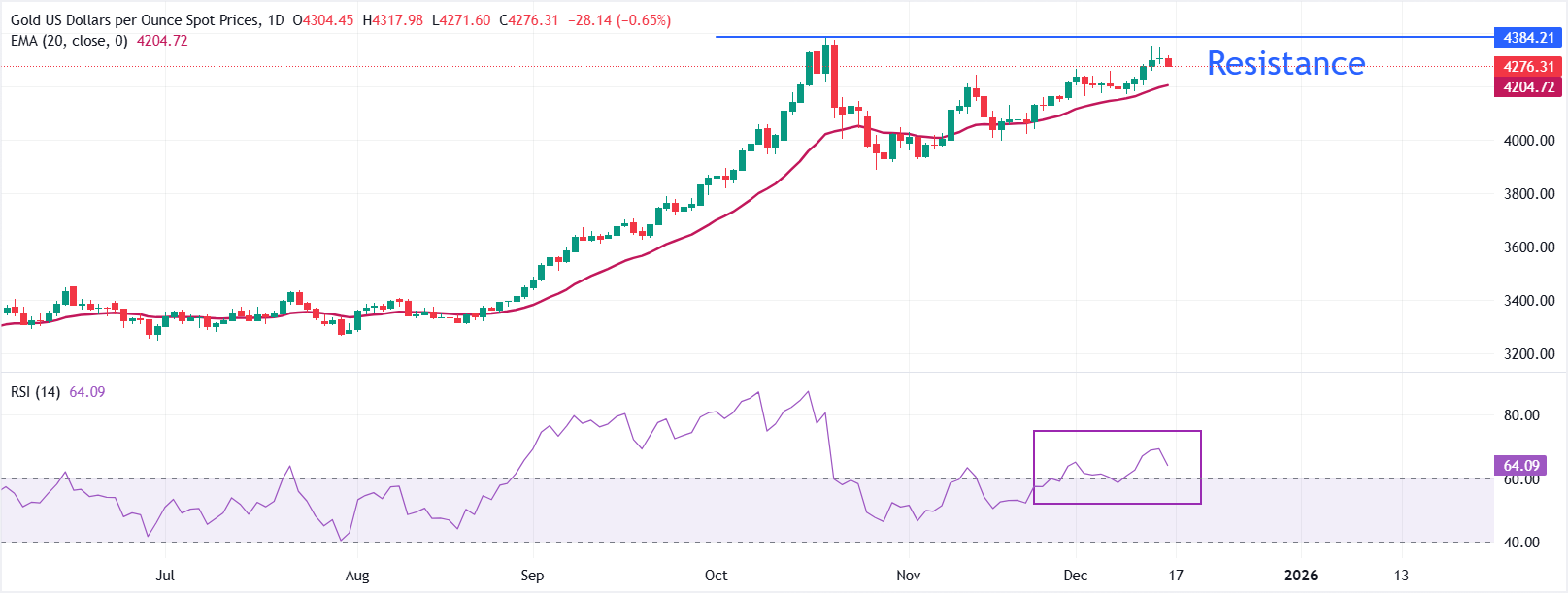
Gold price declines after revisiting near record highs around $4,385. The 20-day Exponential Moving Average (EMA) at $4,204.71 is rising, confirming a bullish near-term trend.
The 14-day Relative Strength Index (RSI) falls to near 64.30 after testing overbought levels around 70.00, signaling indications of a correction phase.
Pullbacks near the 20-day EMA will remain major buys for the Gold price, while a day close below the same could lead to further retracement towards the November 24 low of $4,040. Looking up, fresh upside would set in only if the Gold price gains past its all-time high of $4,385.
Gold FAQs
Gold has played a key role in human’s history as it has been widely used as a store of value and medium of exchange. Currently, apart from its shine and usage for jewelry, the precious metal is widely seen as a safe-haven asset, meaning that it is considered a good investment during turbulent times. Gold is also widely seen as a hedge against inflation and against depreciating currencies as it doesn’t rely on any specific issuer or government.
Central banks are the biggest Gold holders. In their aim to support their currencies in turbulent times, central banks tend to diversify their reserves and buy Gold to improve the perceived strength of the economy and the currency. High Gold reserves can be a source of trust for a country’s solvency. Central banks added 1,136 tonnes of Gold worth around $70 billion to their reserves in 2022, according to data from the World Gold Council. This is the highest yearly purchase since records began. Central banks from emerging economies such as China, India and Turkey are quickly increasing their Gold reserves.
Gold has an inverse correlation with the US Dollar and US Treasuries, which are both major reserve and safe-haven assets. When the Dollar depreciates, Gold tends to rise, enabling investors and central banks to diversify their assets in turbulent times. Gold is also inversely correlated with risk assets. A rally in the stock market tends to weaken Gold price, while sell-offs in riskier markets tend to favor the precious metal.
The price can move due to a wide range of factors. Geopolitical instability or fears of a deep recession can quickly make Gold price escalate due to its safe-haven status. As a yield-less asset, Gold tends to rise with lower interest rates, while higher cost of money usually weighs down on the yellow metal. Still, most moves depend on how the US Dollar (USD) behaves as the asset is priced in dollars (XAU/USD). A strong Dollar tends to keep the price of Gold controlled, whereas a weaker Dollar is likely to push Gold prices up.